Workshop/Course:
Tony Burkin - Leadership and Learning - Interlead
Understanding Mental Complexity to Develop Capacity |
Date: 6/8/15 |
||||||
| Key Learnings Bio from Interlead website 
After working with HR professionals from outside education Tony came to appreciate how schools are no different from other organisations. The challenges of getting the best out of other adults, leading change, developing organisational culture and transforming schools into Learning Organisations (Professional Learning Communities), are he believes, Human Resource issues more than educational ones. “The core business is very different but human psychology remains the same – people are people – we all share the same flaws”, he says.
Tony has presented at conferences and works in schools and educational organisations in New Zealand, Australia and the Middle East. He enjoys particularly in-school development programmes because they provide enormous scope for real cultural change to evolve and allow leaders to develop the influence they have always desired.
Key Findings from the course:
How do you develop capacity in schools? Middle management is very challengingReference: Thinking fast and slow - Daniel KahnemanFast brain is default thinking - forget we have done day to day things eg brushing teeth, driving to school things we do every day. We use fast brain all the time. Fast brain uses the learning already established. Metanoia - To shift your thinking to a higher level- Greeks version of learning- Mind shift Meta -to move to a higher level- to look through what we do know Informational Learning- to impart knowledge ( informational Learning)- technical learning Transformational Learning- to shift knowledge- why are we doing things- motivational learning About the model
The educational leadership model (ELM) sets out the qualities, knowledge, and skills that middle and senior educational leaders need to lead their schools in the twenty-first century.
This model shows that relationships are at the core of school leadership and that leadership always operates within a specific context. It also identifies areas of practice, leadership activities, and the qualities of effective leadership.
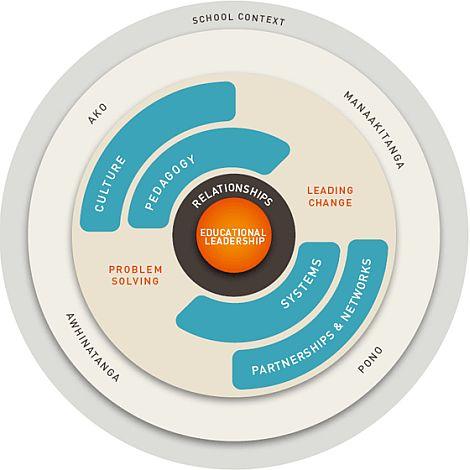 Effecting Change:As a leader you are creating problems for your staff. You are effecting change. You will make people feel uncomfortable at times. But it is about constantly making improvements. In many cases leaders are trapped by their relationships and carry their staff and decisions are affected.
What is the Middle Leaders role?
Middle leaders role: to support the principal to make life uncomfortable for colleagues. The rational for the change needs to be clearly explained and there needs to be buy in from colleagues to effectand embed the change. What are we there for in this job? The Espoused theory would be we are there for Learning, teaching, children, developing relationships, success etc- however when psychologists walked the walk they discovered this did not happen The Reality is :A normal rational human being in the workplace seeks minimising risk to personal image -don't want people to see them as incompetent -dont want people to see them as negative -dont want to be seen as disruptive All these things are around self- interest not about teaching and learning or children Implications for leaders -job is to challenge thinking -you will upset them -they will see you as negative/ may go away feeling negligent - are you prepared to prostitute your moral compass
Leaders effect change . Managers manage the day to day.
We want productive workplaces, not just positive work places.
Research: Amy Edmonson
Complexity of leadership role
Social ( People) Also systems within the school - relief. duties, meeting schedules, some have low level and high level complexities. This creates a complex range of issues
Types of Organisational Complexity
Low Social Complexity ( people ) High
People have potential to deal with increased complexity as they age.
Demands of the job are exceeding the mental complexities of the individual
We have 4 filters (ways of knowing) within our heads
We are talking about the quality of our filters in our head- our mindset- and how that impacts on our way of knowing
Level 2 Instructional way of knowing- 'The Rule Bound Self'
- they want assurances and guarantees- The world is governed by a set of rules- so as long as I know them I'm ok.
Peoples expectations of you as a leader is FIX IT - they don't want to be led they want to be managed. Why do we support them.... because of our social connections and we want to be liked.
- they have a very concrete world black and white
-"just tell me- don't make me think", there is a right way and a wrong way. They want to learn the rules and be given the rules. Parents at this level want the rules. Other people's interests only become important if they interfere with personal needs.Lack the capacity for abstract thinking.
About 13% of the world's population is at this level. Perhaps 25% of teaching staff is at this level.
That is why it is hard for leaders to bring about change.
How can you be a leader if you are at this stage yourself?
Level 3 Socialising way of knowing; 'Other -Focused Self'
Not living their own values, not able to meet own needs autonomously . seeking approval via the relationship- these people are trapped by the relationship. They are influenced by what they think others want to hear rather than what they need to hear. 'What I convey is strongly influenced by what i believe other's want to hear'. everything they do is about maintaining relationships, but your job as a leader is to ruffle their feathers and create change.
People that withhold the truth because they are fearful of upsetting others at this stage.
They feel responsible for other people's feelings- carry the burden and guilt.
As a leader you can't carry the guilt for hurting other people's feelings, if you keep that person's dignity intact and are implementing positive change for the good of the school.
They do not have the capacity to evaluate multiple perspectives
Empathy I put myself in your shoes I see the world through your eyes, but I don't carry your guilt. I understand your world and why you think as you do.
Pedagogy - how you lead children through a process of learning
Andragogy- how you lead adults through a process of learning
Schools are safe places to be because they are rule bound.
Pedagogy research shows us that we should have 6- 8 positive statements to 1 negative
In Andragogy that ratio breeds workplace complacency
Level 4 Self Authoring way of knowing -'Reflective Self'
This self can take action. It's an ethical self- can keep the other persons dignity and your integrity safe. Life is easier, you are not pulled by relationships and what is best for the school.
It's about living comfortably about making difficult decisions. These people are geared to self improvement.
What I choose to convey is strongly influenced by what I believe others need to hear to best further the direction I have set. My focus is for the best interests of my students not necessarily for my teachers.
This has huge implications for professional practice what does it look like, receiving and providing feedback, staff meetings, engaging teachers in learning conversations
This person wants their ideas confirmed.
Level 5 Self transforming way of knowing
A self transformer wants the outside person to transform their thinking. They want others to identify flaws in their thinking. This one has multiple lenses. They don't mind about chopping and changing plans- they realise the world lives in motion- being informed is more important than worrying about changing pathways. Self- transformers have found ways to let others know such information will be welcomed. Leave enough space in their thinking to take up info and create a new space and run with it.
NB this is not about IQ or emotional intelligence EQ
Each filter dramatically influences
What information people communicate
How people convey information conversationally
How people receive that information
What people will do with that information
When levels of complexity exceed the ability of our meaning making systems the world seems weird- we enter the badlands

Actions Ideas to try
1. Buy the book Reference: Thinking fast and slow - Daniel Kahneman
2. View Kiwi Leadership booklet - refer framework educational leadership model which sets out the qualities, knowledge and skills principals need to lead 21st century schools http://www.educationalleaders.govt.nz/Leadership-development/Key-leadership-documents/Leading-from-the-middle/The-educational-leadership-model
Reflections
This learning has significant impact re understanding why people think as they do and to identify people with limited thinking traits within our teams. Some people just like the children that we teach will need scaffolding in order to develop their own thinking filters.
It also leads me to wonder if our education system is not targeting the correct people for promotion to management roles. Because a career pathway in teaching has traditionally been the AP, DP, Principal role, perhaps this does not suit people's thinking filters. Perhaps more investigation should be made into other ways of career pathways such as the new ACET roles?
Further learning arising from this PD
On 27th August there will be a Middle Managers PD run by NZEI re having hard conversations with staff. This would be a natural follow on workshop to support the thinking and learning gained from this PD. As a manager we need to have hard, honest, open conversations with colleagues.
|
|||||||
Thursday, 6 August 2015
The following are my notes taken from a workshop run by Tony Burkin from Interlead. The Course was about understanding Mental Complexity to Develop Capacity in worksites.

Subscribe to:
Post Comments (Atom)
No comments:
Post a Comment